

Ïîäïèñü:

Methods of X-ray Diffractometric Research, Software, Information DataBases

1

Obtaining X-ray diffraction data and its initial processing. Diffraction patterns of samples of polycrystalline materials (powders or polished sections) are obtained on X-ray diffractometers DRON-3M and DRON-4 using Cu Ka radiation  and processed by the method of full profile analysis. …(more details)


2

Qualitative X-ray diffraction phase analysis is carried out using a set of programs developed by us (more details) including two database of reference diffractograms at the program level, namely, the standard PDF-2 DataBase and the DataBase of reference diffraction patterns of intermetallics, oxides, etc. created by us ..(more details)

3

Machine indexing of diffraction patterns of compounds with an unknown unit cell. The metric and symmetry of the unit cell of a newly synthesized compound can be determined using the machine method of indexing its diffraction data. (more details).  A fundamentally new feature of this software is the ability to automatically find a possible analogue for a new compound using the data DataBase of X-ray diffraction patters of structural types of compounds. .


4

Determination and refinement of the crystal structure. Validation of crystal structures according to known structural models and construction of new structural models by the method of trials and errors is performed using a set of programs adapted for use within the framework of an automated system for collecting, processing and interpreting X-ray diffraction data (more details)

5

Quantitative phase analysis. The method developed and implemented by us for determining the quantitative content of phases in a mixture (up to six phase components with known crystal structure) is based on a mathematical algorithm for its refinement simultaneously with the parameters (coordinates, atomic filling coefficients of the corresponding positions, temperature, texture) of the crystal structure of each of the identified phases. (more details)


6

Determination of the preferred orientation in coatings or compact samples which are rotating in their own plane at collecting X-ray diffraction data (more details)

7

Determination of the parameters of  real structure  (macrostresses, microstresses, sizes of coherent scattering blocks) of individual phase components of the sample using X-ray diffraction data (more details)

8

Information data DataBases of crystallographic characteristics of compounds and their diffraction patterns, as an integral part of this complex of programs (more details).


It is known that at each stage of developing the technology for the synthesis of a new material, it is important to obtain the express information about the correlation of its qualitative and quantitative phase composition, crystalline and real structure of the available phase components with physical and functional characteristics of the synthesis product. This opportunity is provided by the optimization of X-ray diffraction methods. The use of a set of application programs equipped with information database of crystallographic characteristics of compounds and their diffraction patterns, allows to provide qualitative and quantitative phase analysis of any polycrystalline material using X-ray diffraction data, as well as to refine the crystal structure and, if necessary, determine the texture and parameters of the fine structure of each phase component. .

The main X-ray diffraction methods that we use in the study of polycrystalline materials are listed below :


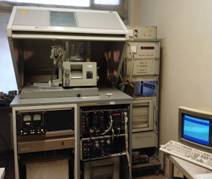
Currently, the Department of Metal Physics is equipped with two automated diffractometers DRON-3M and DRON-4 designed to provide X-ray diffraction studies of polycrystalline substances. The diffraction spectra are collected in a discrete mode, recording the information obtained in a file .