
|
You can search for necessary information in the database using two key elements: 1. In scientific literature, data on the crystal structures of compounds are very often given in non-standard space group settings that do not correspond to [International tables for X-ray crystallography//Birmingham, England: the Kynoch Press. 1951. v. 1. 558 p]. For example, compounds with rhombic structures that belong to the space group Pnma (number 62) are also represented in the settings Pnam, Pmnb, Pmcn, Pbnm, Pcmn. For the space group Cmca (number 64), the settings Ccmb, Bmab, Bbcm, Acam, Abam could be used, for the space group P21/c (number 14) - P21/n, P21/a , etc. The periods of crystal lattices and atomic coordinates from non-standard settings of space symmetry groups (about 150 settings) were converted by us using special programs to the corresponding values in standard settings according to [International tables]. 2. Of the two settings for monoclinic and two for R-rhombohedral structures recommended in [International tables], we have chosen the international (gamma) and hexagonal settings, respectively.. 3. Belonging of the crystal structure of some compound to a certain structural type (in the absence of relevant indications in the literature) was established based on the results of a machine search for possible analogous structures from the DataBase of structural types of inorganic compounds, with further verification by comparing the spatial images of the structures (three of their projections) in a graphic mode reduced to comparable lattice periods. 4. When giving the composition of compounds, its components are placed in order of decreasing atomic radii, which greatly simplifies the automatic search for analogues compounds that are close in composition . 5. Scattering ability of atoms of various chemical elements is taken into account using their atomic functions, OH, H2O groups - using the function for O, NH3 groups - using the function for N, etc. 6. The coordinates of atoms are given in decimal form, negative values and values greater than one are reduced to the interval: 0 < x, y, z < 1. 7. For each structure, only one value of the temperature factor is given - the general isotropic temperature correction, and not anisotropic corrections for each atom, since the information in the DataBase is focused primarily for the interpretation of X-ray diffraction spectra (in this case, the exact consideration of thermal lattice vibrations is not essential).
|

|
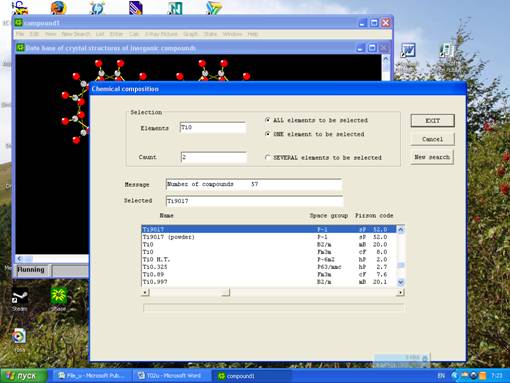
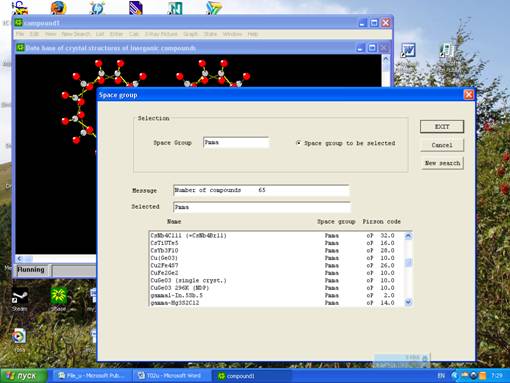
You can search for necessary information in the database using two key elements: 1. By the elemental composition of the compound (chemical element and the number of these elements in a compound). In this case the search can be carried out both by the full composition (AND—all specified elements in a given quantity are included in the compound (All elements to be selected)), and by the alternative composition (OR—at least one of the proposed elements is included in the compound (One element to be selected) or several (Count) of the proposed elements are included in the compound (Several elements to be selected)). Fig. 1. 2. By the symbol of the space group to which the crystal structure of the compound belongs. Fig. 2. |
|
|
|
Fig. 1. Screenshot of the search result for information on the crystal structure of titanium oxides (the search was carried out using the key ALL elements to be selected). |
|
|
|
Fig. 2. Screenshot of the search result for information on the crystal structure of compounds with the space group Pmma |
|
|
|
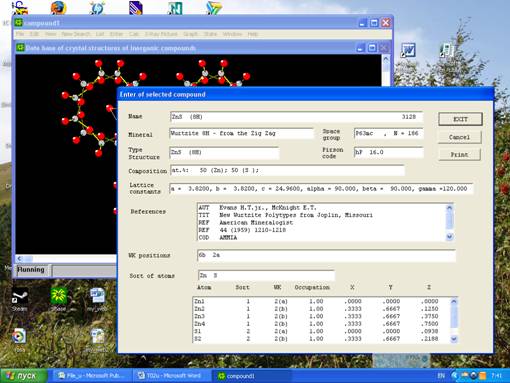
Fig. 3. Information screen on the crystal structure of ZnS (8H) compound |
|
Fig. 4. Information about the crystal structure of ZnS (8H) compound, which is ready to print |


|
|

|
|
![Подпись: Information about the compound selected as a result of the search is presented in the form (Fig. 3) and contains the following positions:
NAM - name of the compound (a chemical formula) (up to 50 characters);
MIN - name of the mineral (up to 40 characters);
TYP - prototype name (type-structure) (up to 40 characters);
COM - composition of the compound (the components are arranged according to the decreasing atomic radius of the atom);
SPG - symbol of the Space-Group Symmetry according to [International tables for X-ray crystallography//Birmingham, England: the Kynoch Press. 1951. v. 1. 558 p];
PIR - Pearson symbol, which gives the real number of atoms in the unit cell of the structure, taking into account availability of vacancies;
LAT - a, b, c lattice parameters (in angstroms) and Ða, Ðb, Ðg angles between crystallographic axes (in degrees);
ELE - chemical types of atoms (up to six elements);
PAR - distribution of the atoms according to their positions taking into account the position filling coefficients, multiplicity and designation of these positions (Wyckoff position);
WKP - list of the positions occupied by atoms and the number of occupied positions of a certain type;
ITF – isotropic temperature factor;
AUT – Authors, TIT – publication title, REF – source, COD—journal code.](image2393.gif)