Crystal Structure Calculation |
|
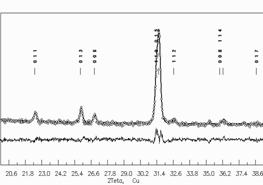
The search for possible structural analogues for the studied compounds with an unknown crystal structure is carried out by: 1. using the DataBase of structural types of inorganic substances (more details) (if it was possible to determine the metric and symmetry of the elementary lattice as a result of machine indexing) ; 2. using a DataBase of graphic images of diffraction spectra of structural types of inorganic substances (more details) . Verification of crystal structures by known structural models, refinement by the least squares method coordinetes and atomic filling of the corresponding positions, temperature factors, texture parameters is performed applying a set of programs [Pecharsky V.K., Zavaliy P.Yu., Axelrud L.G. Complex of structural analysis programs for UVK SM-4// Vestn. Lviv University. Ser. Chemistry. 1974. Issue. 25. P. 9-11], which we adapted for use within the framework of an automated system for collecting, processing and interpreting X-ray diffraction data. Refining the crystal structure of phases in coatings, we take into account the correction for the film thickness . New structural models are created considering the crystallochemical features of the class of the compound studied and according to data on the metric and symmetry of its unit cell obtained by indexing diffraction pattern (more details). The prospects and (further) correctness of a particular model are assessed in a graphical mode by the correlation of the values of the intensities of the experimental and processed by a specific model diffraction reflections of the compound (Fig. 1), as well as by the value of the Bragg’s reliability factor RI . where I(hkl)calc and I(hkl)obs are the calculated and experimental intensity values, hkl are the miller indices .
|

|
Fig. 1 Fragment of the graphical result of the crystal structure refinement of SrEu2Sc2O7 compound (circles—experiment, solid line—processing)
|
|
|