
Determination of Texture in Compact Samples |
|
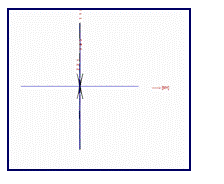
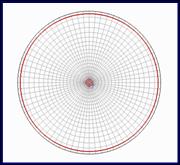
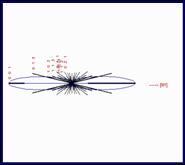
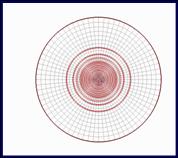
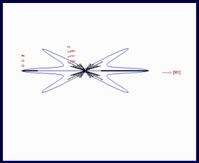
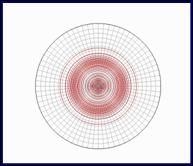
Determining the texture in a sample (coating, section) can be interpreted as the study of the statistical distribution of individual crystals according to their orientation. All common experimental methods for determining texture are laborious and require special diffractometric equipment (texture attachments). However, the express determination of coating’s texture in the normal plane is very important for prompt adjustment of technological modes of coating technology. An effective method for the texture determination is proposed by Pecharsky V.K., Axelrud L.G., Zavaliy P.Yu. in [On the method for taking into account the influence of the predominant orientation (texture) in a powder sample when studying the atomic structure of a substance // Crystallography. 1987. 32. No. 4. P. 874-877] processing the data of conventional X-ray diffractometry in a polycrystalline sample rotating in its own plane. At the same time, another coefficient is introduced into the formula for the reflection intensity hkl - the texture factor, which distorts the sphere of the probability distribution of crystallite orientation into an ellipse with an eccentricity t greater than or less than 1: T = [1 + (t2-1)cos2jhkl]-1/2, where t is the texture parameter ; jhkl is the angle between the inverted lattice node vector In reality the texture axis in films is most often oriented not strictly along the normal to the sample surface, but forms a small angle with it, i.e., the so-called texture scattering occurs at coating deposition. We have proposed (and implemented at the software level) to take into account the texture scattering by introducing not one, but several (up to four) texture multipliers (T1T2T3T4) with texture axes that are crystallographically close to the main texture direction. This approach allows to determine effectively the axis of the film's predominant orientation in the direction perpendicular to its surface and to estimate the degree of texture scattering based on conventional X-ray diffraction data. The results obtained in the study are presented in the form of a graphic image of the indicatrices of statistical weight of X-ray scattering by the corresponding atomic grids of coatings and isolines of the projections of “ellipsoids” of the rotating samples’ texture onto the surface of coatings (sections) (Fig. 1-3) and in the form of a parameter - the texture degree in the selected direction, which is equal to the ratio of the eccentricities of the ellipse.
|

|
|
|
Fig. 1. Indicatrix of the statistical weight of X-rays scattering by atomic lattices of a HoF3 coating and isolines of projections of texture “ellipsoids” onto the surface plane of the coating almost 100 % textured in the [110] direction.
|
|
|
|
|
|
Fig. 2. Indicatrix of the statistical weight of X-rays scattering by atomic lattices of a YbF2 coating and isolines of projections of texture “ellipsoids” onto the surface plane of the coating textured in the [001] direction (low degree of texture scattering). |
|
|
|
|
|
Fig. 3. Indicatrix of the statistical weight of X-rays scattering by atomic lattices of a PbF2 coating and isolines of projections of texture “ellipsoids” onto the surface plane of the coating textured in the [001] direction (high degree of texture scattering).
|

