Determination of the Real Structure Parameters |
|
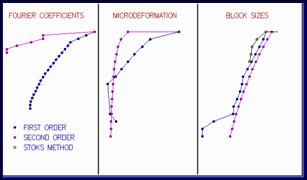
Fig. 2. Functions A(n)=f(n) and lnA(n) for microdistortions of the crystal lattice and the sizes of coherent scattering blocks in ZnS-sphalerite coating.
|
|
The X-ray diffraction method for determining macrostresses (stresses of the first type) in polycrystalline samples is based on the results of precise determination of the crystal lattice periods of the corresponding phase components. The sum of the tangential stress components can be calculated by the equation:
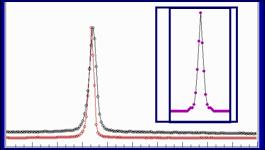
where sx + sy - is the sum of the tangential components of the first-order stresses acting in the plane of the sample; E is the Young's modulus; m is the Poisson's ratio; d0 is the interplanar distances for the reflections of the reference sample, which are recorded at the largest angles in this experiment; Dd is the change in the interplanar distance of a particular reflection in the sample under study compared to the reference If the films under study are strongly textured, it is advisable to estimate the first-order stresses by the values of those crystal lattice parameters that correspond to the main directions of the texture. Previously determined values of the crystal lattice parameters of the corresponding phase components in the unstressed reference material could be used as references. To calculate the first-order stresses, it is also necessary to determine the value of E/m for each material. Considering the possible lack of experimental data on the elastic characteristics of the material, it is advisable to study not the absolute values of the first-order stresses, but their changes in the coatings depending on the technology of their application, that is, to analyze the relative degree of elastic deformation of the film. The determination of the fine structure parameters (microstresses, sizes of coherent scattering blocks, dislocation density) of polycrystalline materials is carried out using two well-known methods, which were implemented by L.G. Axelrud, namely : а) approximation (if it is experimentally possible to record reflections of different orders from the same plane of the sample studied) ; b) harmonic analysis (if only one reflection was recorded experimentally from a particular plane) . The selection of high-quality standards (unstrained materials), the width of the input and output slits on the X-ray tube and detector, and the use of mathematical methods for smoothing experimental peaks (the spline method) allow us to correctly isolate the physical broadening of diffraction peaks from the samples studied and, applying known mathematical algorithms, determine the parameters of their real structure (Fig. 1).
|

|
Fig. 1. Experimental diffraction peaks (111) from an annealed polycrystalline ZnS-sphalerite sample (standard, red circles) and from a model ZnS-sphalerite coating with nd = 2.5 mm (sample, black circles) and the physical broadening identified |
|
The combined use of mathematical methods for processing physical broadening curves (approximation, Stokes, harmonic analysis methods) allows us to obtain reliable information about the sizes of coherent scattering blocks, microstress, dislocation density, etc. The correctness of determining the parameters of the real structure is controlled in graphical mode by the Fourier coefficients A(n)=f(n), as well as lnA(n) (Fig. 2). |


|
|